


South Africa’s built environment is entering a period of significant change. Commercial buildings are being reconsidered around flexibility, operational efficiency and user experience. Industrial developments are becoming more automated, infrastructure-intensive and closely connected to national logistics systems. Data centres are emerging as essential digital infrastructure rather than specialised buildings at the edge of the property market.
These sectors are different, but their architectural futures are increasingly connected. They all depend on resilient power, digital systems, efficient land use, adaptable structures, integrated services and long-term commercial performance.
This changing environment requires Developer-Led Authority and Future-Focused Thought Leadership. Property developers, operators and architectural teams need to respond to more than immediate demand. They must consider how buildings will perform as technology, energy systems, climate pressures and tenant expectations continue to evolve.
Developer-Led Authority and Future-Focused Thought Leadership positions architecture as a strategic tool. It connects development feasibility, technical design, user needs, sustainability and asset performance within one coordinated process.
Piek Architects’ work across commercial projects, industrial developments and data centres provides relevant context for understanding how these sectors may develop in South Africa.
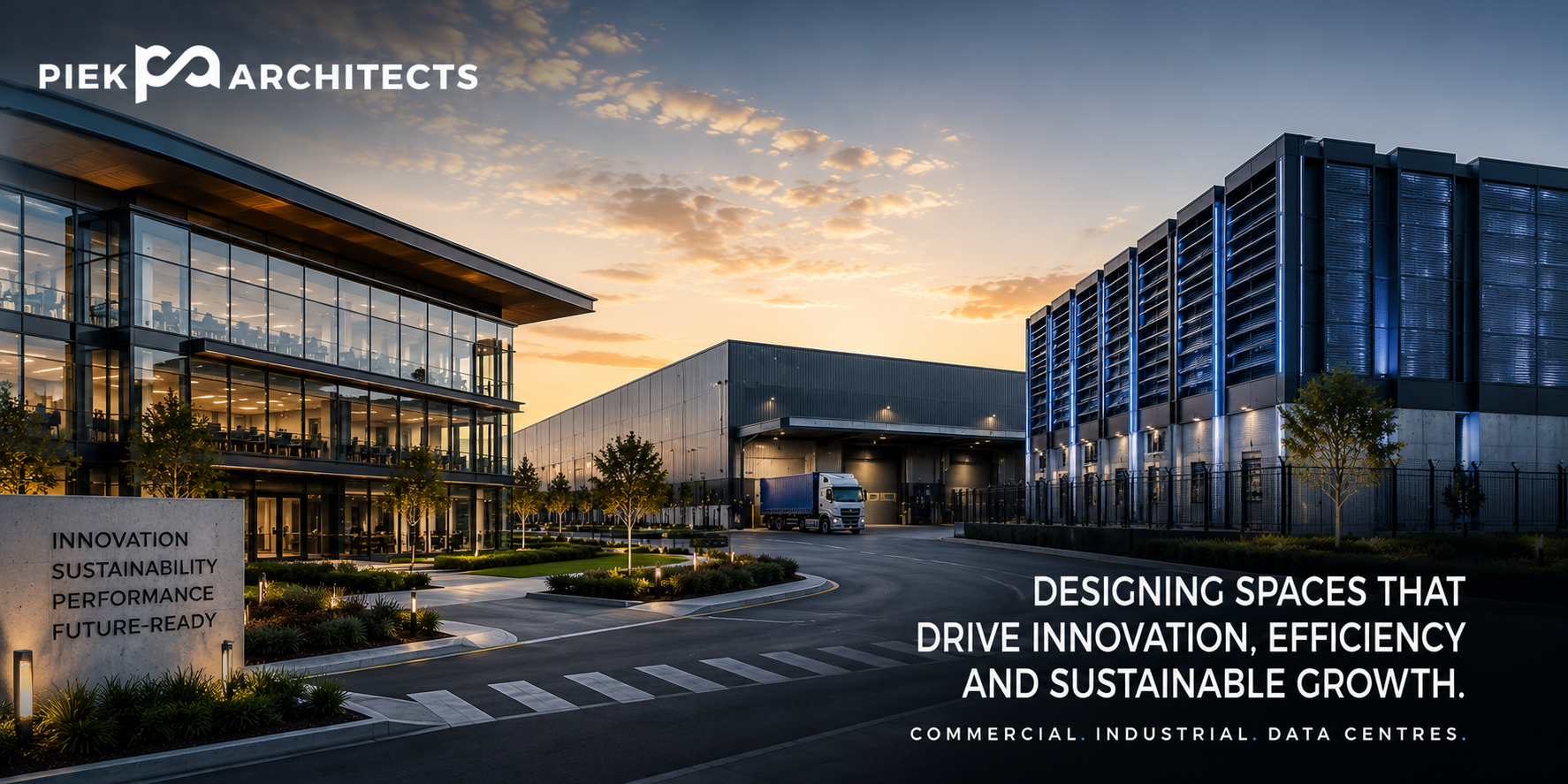

The Built Environment Is Becoming More Integrated
Commercial, industrial and digital property can no longer be viewed separately
Commercial buildings have traditionally been associated with offices, retail and public-facing environments. Industrial architecture has focused on manufacturing, storage and logistics. Data centres have been treated as specialised technical assets.
These categories are now overlapping.
Modern industrial parks include offices, training facilities, customer spaces and digital infrastructure. Commercial precincts depend on high-capacity connectivity and resilient energy. Data centres need industrial-scale land, servicing, security and technical coordination.
Developer-Led Authority and Future-Focused Thought Leadership recognises these connections and avoids designing each building as an isolated object.
The future lies in developments that coordinate architecture, infrastructure, landscape, mobility and technology across entire sites.
Infrastructure will shape development potential
A site may have favourable zoning and market demand but still be unsuitable if it cannot support the required electricity, water, data or road capacity.
This is especially important for manufacturing facilities, logistics centres and data centres. Infrastructure demand can influence where a project is located, how it is phased and how much of the site can be developed.
South Africa’s government increasingly describes data centres, fibre and telecommunications systems as core economic infrastructure. The Department of Communications and Digital Technologies has also identified expanding demand for cloud services, digital platforms and data processing as a driver of further data-centre investment.
Strong Developer-Led Authority and Future-Focused Thought Leadership therefore begins with infrastructure feasibility rather than architectural form.
Architecture will need to respond to uncertain growth
Developers are often required to make long-term capital decisions in uncertain markets.
Commercial tenants may change their space requirements. Industrial operators may introduce new equipment or automation. Data-centre clients may require rapid capacity expansion.
Buildings need to support this change without requiring complete reconstruction.
Developer-Led Authority and Future-Focused Thought Leadership treats adaptability as a commercial requirement. Regular structural grids, accessible services, expansion zones and flexible floorplates can help protect long-term asset value.
Digital infrastructure will influence every property sector
Reliable connectivity is no longer relevant only to technology businesses.
Offices depend on cloud systems and hybrid work. Warehouses use scanning, tracking and warehouse-management platforms. Manufacturing facilities use connected equipment and production data. Retail environments integrate digital transactions and customer analytics.
Government is working to improve the speed and consistency of digital-infrastructure deployment, including processes affecting land access and network rollout.
This reinforces the role of Developer-Led Authority and Future-Focused Thought Leadership in planning suitable data routes, plant spaces, security and future connectivity from the beginning.
The Future of Commercial Architecture
Office buildings will need to earn occupancy
Commercial buildings can no longer depend on location and floor area alone.
Employers and tenants increasingly expect offices to support collaboration, wellbeing, technology and organisational identity. Buildings that provide only generic desks may struggle to compete with more flexible alternatives.
Future office architecture will need to create reasons for people to use the space. This may include better shared areas, adaptable meeting environments, outdoor spaces, natural light and integrated amenities.
Developer-Led Authority and Future-Focused Thought Leadership connects these user needs to leasing strategy and long-term building performance.
Piek Architects’ commercial portfolio provides relevant examples of architecture developed for office and business environments.
Flexibility will become a core leasing advantage
Tenants may expand, contract or reorganise several times during a lease.
Commercial buildings should therefore support different tenant sizes and workplace models. Structural grids, service zones, cores and access-control systems need to allow practical subdivision.
Flexible floorplates can also make buildings easier to reposition when the market changes.
Developer-Led Authority and Future-Focused Thought Leadership sees flexibility as a way to reduce vacancy risk and extend the useful life of the asset.
Mixed-use precincts will continue to evolve
Offices are increasingly connected to retail, residential, hospitality and public space.
Mixed-use developments can create greater activity and convenience, but they require careful planning. Deliveries, residents, workers, visitors and service vehicles may all use the same precinct differently.
Piek Architects’ master planning and urban design services can support the coordination of buildings, roads, open spaces and development phases.
Successful mixed-use design demonstrates Developer-Led Authority and Future-Focused Thought Leadership by connecting uses without creating operational conflict.
Workplace interiors will become more adaptable
Commercial interiors will need to support a wider range of activities.
Focused work, team collaboration, virtual meetings, training and social interaction may all occur within the same workplace. Fixed layouts can become obsolete quickly.
Piek Architects’ interior design services can help coordinate planning, finishes, lighting and furniture with the wider building.
Future-focused workplace design should allow interiors to change without major structural or service alterations.
This practical adaptability strengthens Developer-Led Authority and Future-Focused Thought Leadership.
Commercial sustainability will become easier to measure
Sustainability is moving from broad aspiration towards measurable performance.
Energy, water, indoor quality and operational data can increasingly be monitored after occupation. This allows owners to compare design targets with actual results.
The Green Building Council South Africa provides Green Star and Net Zero certification pathways for new buildings, existing buildings, fit-outs and precinct-scale developments.
The organisation’s 2025 property index also reported long-term outperformance by certified green offices compared with non-certified peers, adding a measurable commercial dimension to sustainable design.
Developer-Led Authority and Future-Focused Thought Leadership uses this evidence to connect environmental performance with asset strategy.
Existing buildings will need intelligent adaptation
The future of commercial architecture will not be limited to new construction.
Older offices may require improved services, flexible interiors, energy upgrades or new uses. In some markets, adaptation may be more viable than demolition and rebuilding.
The architect should assess structure, floor-to-floor height, cores, façades and services before proposing a new development.
Developer-Led Authority and Future-Focused Thought Leadership considers the potential of existing assets alongside greenfield opportunities.
The Future of Industrial Architecture
Industrial buildings will become more technology-intensive
Manufacturing, warehousing and logistics facilities are becoming increasingly connected.
Automated storage, robotics, conveyors, scanning and real-time tracking systems affect floor tolerances, structural loads, service routes and maintenance access.
Architecture must therefore respond to both physical production and digital systems.
Developer-Led Authority and Future-Focused Thought Leadership ensures that technology requirements are incorporated into the spatial and structural brief instead of being added after construction.
Automation will change warehouse planning
Automated systems can increase storage density and processing speed.
They may also require precise floors, greater clear heights, specialised fire strategies and dedicated equipment zones. The building should support these systems without becoming so specialised that it cannot adapt later.
A balance is needed between current operational efficiency and future leasing flexibility.
This is a central challenge for Developer-Led Authority and Future-Focused Thought Leadership in speculative industrial developments.
Logistics performance will influence site value
Industrial sites are valuable when goods and vehicles can move efficiently.
Regional access, road capacity, gatehouse processing, truck circulation and loading-yard dimensions all influence operational performance.
Piek Architects’ industrial project category includes warehousing, logistics and manufacturing developments where operational movement is a major design driver.
Future Developer-Led Authority and Future-Focused Thought Leadership will place greater emphasis on logistics modelling during land assessment and feasibility.
Industrial parks will need stronger masterplans
Large industrial estates often develop over several phases.
The masterplan should coordinate roads, services, security, stormwater, tenant plots and expansion areas. Each phase should function independently while protecting the wider development strategy.
Piek Architects’ urban-design portfolio provides further context for larger sites where long-term structure and phased development are important.
Developer-Led Authority and Future-Focused Thought Leadership prevents early phases from blocking later growth.
Manufacturing buildings will require closer process integration
Industrial architecture will increasingly need to respond to specialised production systems.
Machinery, raw materials, staff movement, maintenance and waste should form part of one coordinated operational sequence. Electrical demand, ventilation, extraction and process water may have significant spatial effects.
The architectural team must work closely with operators and specialist engineers.
Developer-Led Authority and Future-Focused Thought Leadership gives these operational systems equal importance to the external appearance of the building.
Distribution centres will become faster and more responsive
E-commerce and changing supply-chain expectations place pressure on distribution facilities.
Buildings may need more loading doors, rapid sorting, flexible staging areas and improved data infrastructure. Last-mile delivery can introduce a larger number of smaller vehicles alongside conventional trucks.
The site plan must accommodate these different movements safely.
Developer-Led Authority and Future-Focused Thought Leadership considers how customer expectations influence building design and land use.
Energy resilience will remain essential
Industrial operations can be highly sensitive to power interruptions.
Solar generation, batteries, generators and other resilience measures may become part of the standard brief. Roof structures, plant areas and safety zones should allow these systems to be introduced or expanded.
Energy planning should also account for electric vehicles, equipment charging and growing automation demand.
Developer-Led Authority and Future-Focused Thought Leadership integrates resilience with the architecture instead of treating it as a separate engineering package.
Water and stormwater will influence industrial planning
Large roofs and yards generate substantial stormwater runoff.
Attenuation, harvesting and landscape systems need to be coordinated with building platforms and roads. Manufacturing processes may also require water treatment or reuse.
Piek Architects’ landscape design services can work with civil infrastructure to integrate open space, planting and stormwater management.
This approach reflects Developer-Led Authority and Future-Focused Thought Leadership by connecting environmental systems with site performance.
Industrial architecture will need to serve people better
Industrial design often focuses on machinery and vehicles, but staff experience also affects operations.
Employees need safe movement, practical changing facilities, rest areas, daylight and suitable workplace conditions. Training spaces and administrative areas should connect to production without unnecessary risk.
The future of industrial architecture will include a stronger focus on people alongside processes.
Developer-Led Authority and Future-Focused Thought Leadership recognises workforce wellbeing as part of operational resilience.
The Future of Data Centre Architecture
Data centres are becoming critical infrastructure
Data centres support cloud computing, financial systems, communications, e-commerce and public services.
South Africa’s digital-infrastructure roadmap identifies the country as a growing regional data-centre hub, supported by demand for cloud platforms and data processing.
Government has also described digital infrastructure as central to economic development and investment.
This gives data-centre architecture a wider strategic role.
Developer-Led Authority and Future-Focused Thought Leadership treats these facilities as long-term infrastructure assets rather than ordinary industrial shells.
Power strategy will drive site selection
Data centres require reliable and scalable electricity.
The development team should assess available capacity, redundancy, generation, storage and future expansion before completing the architectural concept.
Plant areas can occupy a large portion of the site. Electrical routes and backup systems also need physical separation to reduce common points of failure.
Developer-Led Authority and Future-Focused Thought Leadership ensures that the power strategy and site plan are developed together.
Cooling systems will shape the architecture
Servers generate substantial heat.
Cooling may require large plant areas, external equipment, water systems or specialised air pathways. The architectural layout needs to support efficient operation, maintenance and replacement.
Changes in server technology may also affect future cooling demand.
A data centre should therefore be designed for both current equipment and reasonable future adaptation.
This is another application of Developer-Led Authority and Future-Focused Thought Leadership.
Water use will require careful consideration
Some cooling systems use significant quantities of water.
South African projects need to assess local water availability and resilience. Alternative cooling strategies, reuse and storage may be necessary depending on the location and facility type.
Water demand should be considered during feasibility rather than after the cooling system is selected.
Developer-Led Authority and Future-Focused Thought Leadership connects technology choice to local environmental conditions.
Security will operate at several layers
Data centres require physical and digital security.
The site may include perimeter control, vehicle screening, identity verification, restricted zones and surveillance. Maintenance teams, clients, contractors and operations staff may require different access levels.
Security should be integrated with circulation and emergency planning.
Piek Architects’ data-centre portfolio provides relevant context for architecture in secure, technically demanding environments.
Layered security supports Developer-Led Authority and Future-Focused Thought Leadership by protecting both infrastructure and continuity.
Redundancy requires spatial separation
Backup systems are valuable only when one incident cannot disable them together.
Electrical, cooling and data routes may need to be separated physically. Plant should be positioned to reduce shared risks from fire, flooding, maintenance or equipment failure.
Architectural planning plays an important role in protecting this separation.
Developer-Led Authority and Future-Focused Thought Leadership turns technical redundancy diagrams into buildable spatial strategies.
Modular construction may support faster capacity growth
Data-centre demand can change quickly.
Modular systems may allow capacity to be added in stages. This can reduce initial capital exposure and align development with confirmed demand.
However, modular growth still requires a coherent long-term masterplan for roads, plant, security and utilities.
Developer-Led Authority and Future-Focused Thought Leadership uses modularity within a broader site strategy rather than as an isolated construction method.
Edge data centres may create new building types
Not every digital service requires a large hyperscale facility.
Smaller edge data centres can position computing resources closer to users and connected devices. These buildings may be integrated into urban or industrial environments with different planning and security constraints.
Their scale may be smaller, but their technical requirements remain significant.
Future Developer-Led Authority and Future-Focused Thought Leadership will need to address both large campuses and smaller distributed facilities.
Renewable energy will influence data-centre investment
Data centres require substantial continuous energy.
Renewable-power strategies can help manage operating cost and environmental commitments, but they need to be coordinated with reliability requirements.
Government’s digital-infrastructure roadmap identifies renewable energy as part of its policy direction for supporting data-centre investment.
Developer-Led Authority and Future-Focused Thought Leadership should therefore connect energy sourcing, storage and efficient architecture.
Data sovereignty will remain relevant
The location and management of data have regulatory and commercial consequences.
South Africa’s data and cloud policy framework emphasises privacy, security, connectivity and cloud adoption.
These requirements influence client demand for secure local infrastructure.
Architecture cannot resolve policy questions, but it can create the secure, resilient facilities required to support compliance.
This connection between regulation and physical infrastructure is part of Developer-Led Authority and Future-Focused Thought Leadership.
Shared Priorities Across All Three Sectors
Resilience will become a standard design requirement
Commercial, industrial and data-centre assets all need to cope with disruptions.
Power interruptions, water constraints, extreme weather, supply-chain delays and technology changes can affect operations.
Resilience may include backup systems, flexible layouts, durable materials and protected infrastructure routes.
Developer-Led Authority and Future-Focused Thought Leadership asks how the building will respond when normal conditions are interrupted.
Sustainability will move beyond certification
Certification remains valuable, but future buildings will increasingly be judged by actual performance.
Owners may monitor electricity, water, emissions and indoor conditions over time. These findings can inform maintenance and future development decisions.
The Green Building Council South Africa describes green buildings in terms of energy, water, materials, transport, indoor quality and broader environmental performance.
Developer-Led Authority and Future-Focused Thought Leadership uses certification as one part of a wider performance strategy.
Embodied carbon will receive more attention
Operational energy has traditionally received most of the attention in sustainable buildings.
The environmental impact of concrete, steel, façades and construction processes is also important. Structural efficiency, material selection and reuse may therefore become more prominent.
This requires earlier collaboration between architects, engineers and cost consultants.
Developer-Led Authority and Future-Focused Thought Leadership considers both construction impact and operational performance.
BIM will become more connected to asset management
Piek Architects’ BIM services in South Africa support design coordination and structured project information.
The future opportunity is to carry useful information beyond construction into operations and maintenance.
A well-managed model can help locate equipment, understand service routes and record changes. However, this requires clearly defined information standards.
Developer-Led Authority and Future-Focused Thought Leadership uses BIM to support the asset lifecycle rather than ending its value at handover.
Digital twins may support operational decisions
A digital twin links building information with live operational data.
This may help owners understand energy use, plant performance and occupancy. Data centres and advanced manufacturing facilities are particularly suited to this approach because they already generate substantial operational information.
The value depends on the quality of the underlying data and the decisions it supports.
Developer-Led Authority and Future-Focused Thought Leadership avoids technology for its own sake and focuses on measurable outcomes.
Design teams will become more multidisciplinary
Future projects will require input from more specialists.
Energy, digital systems, cybersecurity, automation, fire engineering, logistics and sustainability may all influence the architectural plan.
The architect’s coordination role will therefore become more important.
Piek Architects’ architectural project management services can support consultant coordination, communication and delivery planning.
This integrated way of working is central to Developer-Led Authority and Future-Focused Thought Leadership.
Technical documentation will remain essential
Digital tools do not remove the need for clear construction information.
Drawings, schedules, details and specifications still determine how buildings are assembled. Complex façades, plant systems, loading areas and secure spaces require careful coordination.
Professional architectural work in South Africa operates within the regulatory framework established by the Architectural Profession Act 44 of 2000.
Developer-Led Authority and Future-Focused Thought Leadership combines innovation with professional responsibility and disciplined documentation.
Adaptability will support long-term asset value
Commercial space may need new workplace layouts. Industrial facilities may accommodate new machinery. Data centres may require denser equipment or different cooling.
Buildings that cannot adapt may become obsolete before their structures reach the end of their physical lives.
Accessible services, flexible grids and expansion strategies reduce this risk.
Developer-Led Authority and Future-Focused Thought Leadership treats adaptability as a long-term investment decision.
Maintenance should influence design earlier
Plant, roofs, façades and technical systems require regular access.
Maintenance routes and equipment-replacement zones should be planned before construction. A building that is difficult to maintain can become expensive and disruptive to operate.
This is particularly important where downtime affects business continuity.
Practical maintenance planning demonstrates Developer-Led Authority and Future-Focused Thought Leadership because it connects design intent with long-term operation.
Development and Delivery Strategies for the Future
Feasibility will need more detailed scenario testing
A single development model may no longer be enough.
Developers can test different tenant mixes, phasing options, energy systems and levels of automation. These scenarios can show how the project may respond to changing demand.
The architect should work with commercial, engineering and operational teams during this process.
Developer-Led Authority and Future-Focused Thought Leadership uses feasibility to compare possible futures rather than confirm one initial assumption.
Masterplans should protect infrastructure corridors
Future services often require more space than expected.
Industrial and data-centre developments should preserve routes for power, water, fibre and cooling infrastructure. Commercial precincts may also need future transport or energy upgrades.
These corridors should remain accessible and should not be blocked by early buildings.
Piek Architects’ master planning services can support this long-term coordination.
Protecting these routes is a practical form of Developer-Led Authority and Future-Focused Thought Leadership.
Procurement should match technical complexity
Complex buildings may benefit from early contractor and specialist involvement.
However, responsibilities should remain clear, and design decisions should be documented properly. Specialist equipment suppliers may need to contribute information before the architectural design is complete.
The procurement strategy should recognise these dependencies.
Developer-Led Authority and Future-Focused Thought Leadership aligns design, cost, programme and technical information instead of treating procurement as a later construction decision.
Project management will need to accommodate rapid change
Technology and client requirements may change during design.
The project team needs a disciplined process for decisions, revisions and approvals. Uncontrolled changes can create clashes, cost increases and programme delays.
Piek Architects’ project management service provides a framework for coordinating complex project information.
This discipline supports Developer-Led Authority and Future-Focused Thought Leadership by allowing innovation without losing control of delivery.
Commissioning will become more important
Building performance depends on how systems are installed, tested and operated.
Commercial HVAC, industrial equipment and data-centre power or cooling systems all require commissioning. Operators also need appropriate training and records.
A successful handover should confirm that the building performs as intended.
Developer-Led Authority and Future-Focused Thought Leadership includes commissioning and operational readiness within the development programme.
Post-occupancy information should improve future projects
Developers and architects can learn from completed buildings.
Energy data, maintenance records, tenant feedback and operational performance can reveal whether design decisions created value.
These findings should inform future briefs and technical standards.
This continuous learning process deepens Developer-Led Authority and Future-Focused Thought Leadership over time.
Communicating Future-Focused Architecture
Thought leadership should reflect completed work
The strongest architectural thought leadership is supported by evidence.
Developers and practices should explain how projects respond to energy, movement, flexibility and technology rather than relying on broad claims about innovation.
Piek Architects’ LinkedIn page provides a professional channel for sharing commercial, industrial and development work within this context.
Credible communication strengthens Developer-Led Authority and Future-Focused Thought Leadership when it connects ideas to actual projects and delivery experience.
Visualisation can explain complex systems
Industrial and data-centre projects may be difficult for non-specialists to understand from plans alone.
Three-dimensional models and renders can help explain phasing, infrastructure, security and circulation. They can also help stakeholders test the relationship between architecture and technical systems.
Piek Architects’ Instagram profile provides examples of project imagery and architectural visualisation used to communicate design.
Visual clarity can support Developer-Led Authority and Future-Focused Thought Leadership when it helps stakeholders make better decisions.
Project updates should communicate progress honestly
Large developments often take years to complete.
Clear communication can explain milestones, design decisions and construction progress. Piek Architects’ Facebook page offers another natural platform for project and company updates.
The value of this communication lies in accuracy rather than exaggerated claims.
Honest progress reporting is part of Developer-Led Authority and Future-Focused Thought Leadership because it builds trust across long project timelines.
Key priorities for future-focused architecture
The major priorities include:
- Resilient electricity, water, data and transport infrastructure
- Flexible buildings that can accommodate changing users and technology
- Masterplans that protect future phases and service corridors
- Efficient structures, services and operational circulation
- Integrated sustainability with measurable performance
- BIM-supported design, construction and asset information
- Strong security, fire and business-continuity planning
- Practical maintenance and equipment-replacement access
- Multidisciplinary coordination from feasibility through commissioning
- Evidence-based communication and post-occupancy learning
This is the only bullet-point section in the article. These priorities should be addressed as a connected development strategy rather than separate technical additions.
Choosing an Architectural Partner for Future-Focused Projects
Relevant sector experience remains essential
Commercial, industrial and data-centre projects involve different risks.
The architectural team should demonstrate relevant completed work and explain its role clearly. Experience should be assessed against the scale, technical requirements and development model of the proposed project.
Piek Architects’ complete project portfolio provides context across several of these sectors.
Sector experience supports Developer-Led Authority and Future-Focused Thought Leadership by grounding future ideas in practical delivery knowledge.
Integrated services can improve coordination
Large projects may benefit from an architectural practice that understands several layers of the development.
Piek Architects combines bespoke architectural design with master planning, landscape, interiors, BIM and project management.
This does not remove the need for specialist consultants, but it can strengthen coordination between the site, building and user experience.
Integrated capability is an important part of Developer-Led Authority and Future-Focused Thought Leadership.
The team should understand commercial outcomes
A future-focused building must remain commercially viable.
The architect should understand development yield, leasing, construction cost, operating expenses and future adaptability. Technical innovation should support the business case rather than weaken it.
The team should be able to explain where investment creates long-term value.
This ability to connect architecture with asset performance defines Developer-Led Authority and Future-Focused Thought Leadership.
Professional responsibility should remain clear
Innovation does not reduce the need for accountability.
The architectural appointment should identify scope, responsibilities, deliverables and professional leadership. Consultant roles and digital-model requirements should also be clear.
Projects become more complex when new technologies and specialist systems are introduced.
Clear professional responsibility allows Developer-Led Authority and Future-Focused Thought Leadership to move from an ambition into a deliverable project strategy.
Conclusion
The future of commercial, industrial and data-centre architecture in South Africa will be shaped by resilience, technology, infrastructure and adaptability.
Commercial buildings will need to provide more flexible and valuable user environments. Industrial facilities will become more automated and digitally connected. Data centres will continue to grow in strategic importance as part of the country’s digital economy.
These sectors will also become more interdependent.
They will rely on coordinated energy, connectivity, security, water and transport systems. Architecture will need to integrate these requirements with commercial feasibility and long-term asset performance.
Developer-Led Authority and Future-Focused Thought Leadership provides a practical framework for this future.
It encourages developers and design teams to think beyond immediate floor area and construction. It focuses attention on how buildings will operate, adapt and create value over time.
The most successful projects will not simply include more technology. They will use technology, infrastructure and architectural planning in a disciplined way.
Through informed feasibility, master planning, BIM, technical coordination and project management, South Africa can create commercial, industrial and digital assets that remain relevant in a rapidly changing economy.
Frequently Asked Questions
What is the future of commercial architecture in South Africa?
Commercial architecture is likely to focus increasingly on flexible workplaces, mixed-use precincts, measurable sustainability and the adaptation of existing buildings.
What is Developer-Led Authority and Future-Focused Thought Leadership?
Developer-Led Authority and Future-Focused Thought Leadership is an approach that connects informed development decisions, technical innovation and long-term asset performance.
How will industrial architecture change?
Industrial architecture will become more automated, connected and infrastructure-intensive, with greater emphasis on energy resilience and flexible expansion.
Why are data centres important to South Africa?
Data centres support cloud computing, financial systems, communications, digital services and wider economic infrastructure.
What influences data-centre site selection?
Power capacity, connectivity, water, security, land, environmental risk and expansion potential are major considerations.
Why is adaptability important?
Adaptability allows buildings to respond to changing tenants, equipment, technology and operating models without complete redevelopment.
How does BIM support future-focused projects?
BIM helps coordinate architecture, structure, services and specialist systems while creating more reliable project information.
Will sustainability remain important?
Yes. Energy, water, carbon and resilience are becoming increasingly important to investors, operators and building users.
What is the role of master planning?
Master planning coordinates buildings, roads, infrastructure and future phases across large or mixed-use sites.
How can commercial buildings remain competitive?
They can provide flexible spaces, strong user experiences, efficient services and measurable environmental performance.
What makes industrial buildings future ready?
Suitable clear heights, regular structural grids, adaptable services, expansion areas and digital infrastructure can improve future readiness.
What should developers look for in an architecture firm?
Developers should assess relevant sector experience, technical coordination, BIM capability, commercial understanding and the ability to manage complex delivery.